
Contents:
- Quick Answer
- Context: Why Curls Behave Differently From Straight Hair
- The Curl Type System in Plain English
- Why Texture Match Matters More Than Colour
- Colour Can Be Adjusted, Texture Cannot
- Texture Shows From Every Angle
- Mismatched Texture Damages Natural Curls
- The Five Texture Factors to Check Before Anything Else
- Why Shrinkage Is the Hidden Trap
- How to Find Your Texture Match at Home
- Step-by-Step Self-Check
- Which Extension Methods Suit Curly Hair
- Matching Specific Curl Families
- Waves and Loose Curls (2B to 3A)
- Defined Curls (3B to 3C)
- Coils and Kinks (4A to 4C)
- A Quick Cost Breakdown for 2026
- Where the Money Is Worth Spending
- Practical Tips for a Seamless Blend
- Before the Appointment
- During the Fitting
- At Home
- Real Examples: Three Common Situations
- Example 1: The 3B Client Who Wanted Length
- Example 2: The 4C Client Seeking Volume, Not Length
- Example 3: The Mixed-Pattern Head
- Where Colour Fits In After the Texture Is Settled
- Three Small Colour Adjustments That Make a Big Difference
- Porosity, Density and Why They Affect the Blend
- Preparing Natural Curls Before a Fitting
- Living With Your Set: A Realistic Maintenance Calendar
- Seasonal Adjustments
- Questions Worth Asking Any Salon Before You Book
- Protecting Your Natural Hair Underneath
- Choosing Between Curly and Kinky Ranges in Practice
- Common Mistakes People Make With Curly Extensions
- Why a Specialist Salon Changes the Result
- Frequently Asked Questions
- Can I get curly hair extensions if my hair is short?
- Do curly extensions need different care from straight ones?
- How long do curly hair extensions last?
- Can I straighten curly extensions?
- Is it better to match my natural texture or choose a different one?
- Final Word on Curly Hair Extensions
What if the single detail you have been obsessing over when shopping for curly hair extensions, the shade, is the one that matters least? Colour can be toned, glossed and blended by a good colourist in a single visit. A curl pattern cannot be argued with. Put a loose wave beside a tight coil and no amount of perfect highlighting will stop the join from showing the moment your hair gets wet, shrinks or dries in its natural shape.
This guide is for anyone with curls, waves or coils who wants extensions that look like they grew from their own head. It explains how curl patterns work, why texture is the foundation of a seamless blend, how to find your match, what the process costs in 2026 and how to look after the result. Along the way, there are real-world scenarios, practical shortcuts and a few things professionals wish more clients knew before their first appointment.
Quick Answer
Quick Answer: Texture matters more than colour because colour is a surface property that can be adjusted, while curl pattern, curl diameter and density are structural and cannot be changed without damage. Match the curl type first (for example 3B or 4A), check density and shrinkage second, and choose the shade last. Expect to spend roughly £300 to £1,200 for a first set in the UK, plus £80 to £200 for each maintenance visit every six to ten weeks. A specialist consultation, ideally with your hair worn natural and unstyled, is the best way to get a true match.
Context: Why Curls Behave Differently From Straight Hair
Straight hair grows from a round follicle and falls in a predictable line. Curly hair grows from an oval or curved follicle, which makes the strand flatten, twist and spiral as it emerges. The tighter the curve of the follicle, the tighter the curl. This structure gives curly hair its volume, its bounce and its tendency to be drier, because natural scalp oils travel down a spiral far less easily than down a straight shaft.
It also explains why a generic wavy or straight extension rarely blends. Straight hair can be bent into a curl with heat, but that curl lasts only until the next wash or humid day. Natural curls, on the other hand, return to their shape every time. When the extension and the natural hair do not share a pattern, they drift apart over the course of the day, and the difference becomes obvious.
The Curl Type System in Plain English
The most widely used shorthand sorts hair into types 2 to 4, each with subcategories A, B and C. It is not scientific, and most people have more than one pattern on their head, but it gives stylists and clients a shared vocabulary.
- Type 2 (waves): an S-shaped bend that starts mid-length. 2A is loose and barely there, 2C is defined and close to a curl.
- Type 3 (curls): clear spirals. 3A has loose loops about the width of a thick marker, 3B has springy ringlets about the width of a pencil, and 3C has tight corkscrews about the width of a straw.
- Type 4 (coils and kinks): very tight bends. 4A forms a small S-shaped coil, 4B bends in a Z-shape with sharp angles, and 4C is the tightest, often with little visible definition until it is stretched or wet.
Real heads rarely sit neatly in one box. The hair around the crown might be 3C while the nape is 4A, and the front might be looser than the back. Any good matching process should assess several areas of the head, not just a single lock.
Why Texture Match Matters More Than Colour
Three reasons explain the hierarchy, and each one affects how the extensions look and last.
Colour Can Be Adjusted, Texture Cannot
Human hair extensions can be toned, glossed, root-smudged and even lightly coloured to match. A colourist can bridge the gap between a close shade and a perfect one in under an hour. Texture does not offer that flexibility. Heat styling can temporarily alter a curl, and perm-style treatments can change it chemically, but both risk damaging the hair and neither produces the soft, natural spring of a true match.
Texture Shows From Every Angle
Colour is judged mostly by the eye in a certain light. Texture is judged by sight, touch and movement all at once. A smooth extension mixed into coily hair feels different under the fingers, moves differently in wind and sits at a different volume. People may not be able to say why a hairstyle looks off, but they can sense it.
Mismatched Texture Damages Natural Curls
If you try to force your natural curls to match straighter extensions, you commit to daily heat. If you try to force straighter extensions to match your curls, you commit to constant re-curling. Either route adds stress and cost. A properly matched set removes the need for both, so the natural hair is left alone.
The Five Texture Factors to Check Before Anything Else
Matching texture is not a single decision. Five separate measurements decide whether a set blends.
- Curl pattern. The overall shape, whether wave, spiral, coil or zig-zag.
- Curl diameter. The width of each loop or coil. Two sets can both be called 3B yet differ enough to show.
- Density. How much hair grows per square centimetre on your scalp. High-density heads need more wefts or strands to avoid a sparse look.
- Strand thickness. Fine, medium or coarse. Fine hair needs lighter extensions, while coarse hair can carry heavier ones.
- Shrinkage. The amount your curls shorten when they dry. Type 4 hair can shrink by 50 to 75 per cent, which means a stretched length of 40 centimetres might look like 12 when worn natural.
Why Shrinkage Is the Hidden Trap
Shrinkage catches out more first-timers than any other factor. A set that looks the right length when stretched can end up far longer than the natural hair once both are in their curled state. If the extension has less shrinkage than your natural hair, it will hang below your curls in a visible step. Specialists measure length in both states for this reason, and a good consultation includes asking you to wet a section and let it spring up.
How to Find Your Texture Match at Home
You cannot replace a professional assessment, but a few simple checks give you a useful starting point before you book.
Step-by-Step Self-Check
- Wash your hair with a gentle shampoo and apply a light conditioner. Skip heavy oils.
- Let it air dry fully without brushing or stretching it.
- Take photos in natural daylight from the front, side and back, and a close-up of the crown and nape.
- Measure a single curl stretched flat and again in its natural state. The difference is your shrinkage.
- Note how the hair feels: fine like silk thread, medium like cotton, or coarse like wool.
Bring these photos and numbers to your consultation. They help the specialist see your baseline and save time on guesswork.
Which Extension Methods Suit Curly Hair
The method matters almost as much as the match, because some attachment types behave better with curls.
- Keratin bonds: individual strands fused to small sections of hair. They move naturally and allow the curls to bounce freely, but they need sufficient length and density to hide the bonds.
- Hand-tied or micro wefts: thin tracks sewn or attached close to the scalp. They suit very full or tightly coiled hair and offer fast volume.
- Clip-ins: removable and low commitment, useful for special occasions or for testing a texture before committing to a fitted set.
- Tape-ins: thin, flat panels that work well on straighter or looser curls but can be harder to hide in dense coils.
For clients looking for curly hair extensions uk specialists can match, it helps to choose a salon that works with textured hair every day rather than treating it as an occasional request.
Matching Specific Curl Families
Waves and Loose Curls (2B to 3A)
This group is the most flexible. A slightly wavy or loosely curled extension can often be blended with a light wash-and-go routine, and a small amount of styling product will help the two pull together. The risk here is going too tight or too straight, which creates a stiff line where the extension begins.
Defined Curls (3B to 3C)
Spiral curls need extensions with a similar diameter and spring. When the curl diameter is off by even a few millimetres, the join shows up as a change in rhythm between loops. These patterns also shrink noticeably, so length should be assessed wet and dry.
Coils and Kinks (4A to 4C)
Tight coils are the hardest to match and the most rewarding to get right. Strands must bend at the same angle, hold similar density and shrink to the same degree. This is where a dedicated range matters, and specialists who offer kinky hair extensions in several true coil patterns, as Ivana Farisei does, remove the guesswork that comes with trying to adapt a looser texture.
A Quick Cost Breakdown for 2026
Prices vary by salon, region, hair quality and method, so the figures below are typical UK market ranges rather than a quote from any single business. For exact numbers, always request a written estimate after consultation.
- Consultation: free to £50, often credited against the booking.
- Extension hair (full set): roughly £150 to £700 depending on length, quantity and quality. Raw or cuticle-aligned curly hair sits at the higher end.
- Fitting labour: roughly £150 to £450 for two to five hours of work.
- Maintenance (every 6 to 10 weeks): roughly £80 to £200 per visit.
- Aftercare products: roughly £40 to £100 for a sulphate-free shampoo, conditioner, leave-in and a silk bonnet or pillowcase.
That puts a realistic first-year budget between about £800 and £2,500, including four to six maintenance appointments. A well-cared-for set of human hair can be reused after a move-up, which lowers the cost of year two significantly.
Where the Money Is Worth Spending
If budget is tight, spend on hair quality and the consultation before anything else. Cheap curly hair is often straight hair that has been processed into a curl pattern, and the curl can relax or frizz within weeks. A slightly smaller set of authentic, well-matched hair looks better than a larger set of the wrong texture.
What the Pros Know: Always ask whether the curl is natural or processed. Naturally curly donor hair keeps its pattern when wet and dry, while chemically set curls can loosen after a few washes. A reputable supplier will tell you without hesitation.
Practical Tips for a Seamless Blend
Before the Appointment
- Arrive with clean, product-free hair, ideally air dried so the stylist can see your true pattern.
- Bring photos of the look you want, and also photos of looks you dislike.
- Mention any heat styling, chemical straightening or colouring you have done in the past year.
During the Fitting
- Ask the stylist to check the match on a damp section, not just dry hair.
- Request that the front and sides are placed with care. These areas show texture mismatches first.
- Confirm how the set will be trimmed. Curly hair should be cut dry, curl by curl, to preserve shape.
At Home
- Detangle only when the hair is wet and coated in conditioner, starting from the ends and working up.
- Use a wide-tooth comb or fingers. Avoid brushing dry curls.
- Refresh curls with a light water mist and a small amount of leave-in rather than re-washing every day.
- Sleep on silk or satin, or tie the hair in a loose high pineapple with a satin scrunchie.
- Wash every 7 to 10 days with a sulphate-free shampoo, focusing on the scalp and letting the suds run down the lengths.
Real Examples: Three Common Situations
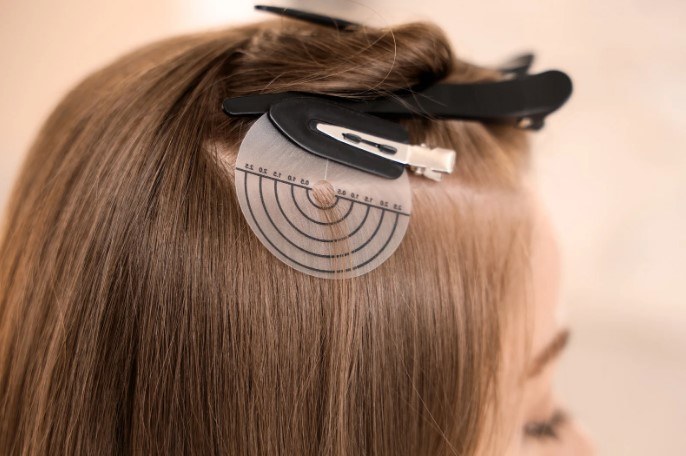
The following scenarios are composites based on typical consultations, included to show how the principles work in practice.
Example 1: The 3B Client Who Wanted Length
A client with springy 3B curls at shoulder length wanted an extra 20 centimetres. Her first instinct was to pick a shade that matched her honey-brown base. The specialist asked her to wet a section instead. Her natural hair shrank by roughly 60 per cent, so a stretched extension of 45 centimetres would have looked like it fell far below her real curls. They chose a hair with a similar diameter and a matching shrinkage rate, then adjusted the shade slightly with a gloss. The result blended in both states.
Example 2: The 4C Client Seeking Volume, Not Length
Another client had dense 4C coils and wanted fullness rather than extra length. A straighter set would have required daily heat to match. The specialist selected a coily texture with the same tight angle, then used a lighter weight at the hairline so the join stayed invisible. Because the pattern matched, she could wear a wash-and-go twist-out with no extra styling at all.
Example 3: The Mixed-Pattern Head
A third client had 3C curls at the crown and looser 3A waves at the nape. A single texture would have looked wrong on one area or the other. The solution was to blend two textures in the same set, placing the tighter curl through the top and the looser curl underneath. This is a good reminder that matching hair is not about one label but about mapping the whole head.
Where Colour Fits In After the Texture Is Settled
None of this means colour is unimportant. It simply comes second, and it is easier to get right once the structure is correct. Curly hair has a particular quirk: colour reads differently on a spiral than on a flat strand. Light bounces off the outside of each curl and disappears into the shadows between loops, so curly hair often looks a shade or two deeper than it would if it were straightened. A swatch held flat against the skin can therefore mislead.
The practical fix is to compare colour on curled hair, not on a straight sample. Ask to see the extension coiled around a finger, or better, a sample with the same curl pattern already formed. Then check it in daylight by a window, because salon lighting is usually warmer and flatter than the real world. If the shade is a close but not perfect match, a colourist can adjust it with a toner or gloss, and can add a touch of depth at the root to mimic the natural shadow where hair meets scalp.
Three Small Colour Adjustments That Make a Big Difference
- Root shadow: a slightly darker root on the extension hides the join and reads as natural regrowth.
- Dimension: a few lighter or darker strands woven through add the variation real hair always has. A single flat shade looks like a wig.
- Gloss: a clear or tinted gloss evens out the finish between your hair, which has been exposed to sun and styling, and brand-new extension hair.
Porosity, Density and Why They Affect the Blend
Two other qualities rarely appear on a shopping list yet influence how a set looks after a few weeks. Porosity describes how readily the hair takes in and loses moisture. High-porosity curls, often the result of colouring, heat or simple genetics, soak up water quickly and dry out just as fast. Extensions tend to be lower in porosity because they are cuticle-aligned and untreated, so they can look glossy and smooth against thirsty natural curls. Regular deep conditioning on your own hair closes that gap over time.
Density works differently. If your natural hair is dense and the extension is sparse, the added strands will look thin and stringy against the surrounding curls. If your natural hair is fine and the extension is heavy, it will pull and weigh down the roots. A specialist will aim for a similar visual weight on both sides of the join, which sometimes means using fewer wefts than a client expects or thinning out a heavy set before it is fitted.
Preparing Natural Curls Before a Fitting
Healthy curls are a better foundation than damaged ones, and the weeks before an appointment are a good moment to improve their condition. Experienced fitters often suggest a simple routine for the fortnight beforehand.
- Use a moisturising mask once or twice a week to soften dry ends.
- Trim split ends at least a week before the fitting, not on the day. Clean ends hold bonds and wefts more securely.
- Avoid protein-heavy treatments immediately before the appointment, which can leave the hair stiff and brittle.
- Stop any heavy oil use on the scalp for three or four days, so attachments grip cleanly.
- Resist the urge to stretch or straighten the hair for the appointment. Natural, unstyled curls give the clearest reading of pattern and shrinkage.
Living With Your Set: A Realistic Maintenance Calendar
Curly extensions are not a fit-and-forget purchase. Knowing the rhythm of upkeep makes the cost and effort easier to plan.
- First 48 hours: avoid washing, heavy sweating or tight styles while attachments settle.
- Weeks 1 to 2: expect a short adjustment period. The scalp may feel slightly tight for a day or two. Persistent pain is not normal and should be checked.
- Every 7 to 10 days: a full wash and deep condition. In between, refresh with water and leave-in.
- Weeks 6 to 10: a maintenance visit to move attachments back up as natural hair grows and to refresh the shape.
- Every 3 to 4 months: a trim and a gloss if colour has faded.
- Months 6 to 12: assess whether the hair can be reused. Quality curly hair often can, which reduces the cost of the next fitting.
Seasonal Adjustments
Humidity makes curls swell and frizz, so summer routines should lean on lighter gels and plenty of rinsing after swimming. Winter does the opposite. Dry indoor air and cold wind strip moisture, so richer creams, covered styles and satin-lined hats help. Many clients find the hair behaves best when their routine shifts slightly every season instead of staying fixed all year.
Questions Worth Asking Any Salon Before You Book
A short list of questions reveals a lot about whether a salon understands textured hair. The answers are often more informative than the portfolio photos.
- How many curl patterns do you stock, and can I see them wet and dry?
- Do you assess shrinkage during the consultation?
- Is the donor hair naturally curly or chemically processed?
- Who will do my fitting, and how many curly clients do they see each week?
- What does a maintenance visit cost, and what is included?
- Will the set be cut dry, curl by curl, after it is fitted?
Ivana Farisei is a good example of the kind of place that welcomes these questions. The consultation starts with your own hair in its natural state rather than a catalogue, and the stylists are comfortable explaining why a particular curl diameter will or will not blend. A salon that answers openly, with specifics, is usually one that expects its work to stand up to scrutiny.
Protecting Your Natural Hair Underneath
The extension is only as good as the hair it is attached to. Curly hair is more prone to breakage at the root and the nape, where friction from collars, pillows and hands is highest. A few habits protect the natural hair for the long term.
- Avoid very tight ponytails and buns, which put leverage on the attachments.
- Keep the scalp clean. Product build-up inside tracks or around bonds can cause irritation.
- Do not sleep with wet hair. Damp roots loosen attachments and encourage matting.
- Take a break between sets if your hairdresser advises it, especially if you notice thinning at the hairline.
These habits also extend the life of the extensions themselves. Hair that is cared for from root to tip can be moved up several times, and each reuse lowers the price per month of wear.
Choosing Between Curly and Kinky Ranges in Practice
Clients often ask where the line falls between a curly and a kinky texture, and the honest answer is that it depends on the head in front of the stylist. A general guide is that curls form visible loops, while kinky textures form tight, small-diameter coils that bend at sharp angles and shrink dramatically. If your hair forms clear spirals when wet and you can slide a finger through each loop, you are in curl territory. If the strands zig-zag in tiny bends and the length seems to vanish as it dries, you are closer to kinky.
The distinction affects more than the label. Kinky hair needs extensions that can mimic its density without looking compressed, and the attachment method has to sit flat within tight coils. After fitting several of these sets, the team at Ivana Farisei tends to recommend a short test: place a few sample strands against a wet section of hair and wait two minutes for both to settle. If the sample coils up and meets your hair at the same height, the texture is right. If it hangs lower or stays looser, the range is wrong, however attractive the shade.
That test costs nothing, takes a couple of minutes and prevents the most expensive mistake in the whole process, which is buying an entire set before discovering the texture does not blend.
Common Mistakes People Make With Curly Extensions
- Choosing by shade first. Some sellers display colour charts prominently and mention texture as an afterthought. This pushes buyers to prioritise the wrong thing.
- Judging the match on stretched hair. Without seeing the natural shrunken state, the stylist and the client are both working from an incomplete picture.
- Buying straight hair and curling it. Heat curls fall out, and the daily routine damages both natural and extension hair.
- Skipping the trim. Extensions that are never shaped to the curl pattern often sit in a heavy, blunt line.
- Using heavy oils on bonds or tracks. Oil near the attachment point can loosen it and shorten the life of the set.
- Delaying maintenance. Curly hair tangles at the root faster than straight hair, and overgrown attachments create knots that are painful to remove.
Why a Specialist Salon Changes the Result
Matching texture is a skill built from repetition. A stylist who fits curly and coily extensions daily learns how different curl families fall, how they shrink and how they respond to humidity. At Ivana Farisei, the process starts with seeing the hair in its natural state, and the team treats texture as the first decision and the shade as the last. That ordering sounds simple, yet it is the reverse of what many clients expect, and it is the reason the finished sets tend to look like part of the head rather than something placed on top of it.
The other advantage of a specialist is range. If a salon stocks only one or two curly textures, every client is forced to compromise. A wider selection, covering waves through to tight kinks, lets the match be chosen rather than approximated.
A final note on ordering: the sequence of decisions is part of the result. Texture first, then density and length, then method, then colour. Clients who reverse that sequence usually end up paying for corrections, while those who follow it tend to need only routine maintenance.
Frequently Asked Questions
Can I get curly hair extensions if my hair is short?
Yes, though the method matters. Short curls shrink, so extensions need to be longer than the target look. Keratin bonds and micro wefts both work, provided your natural hair is long enough to hide the attachment, usually at least 8 to 10 centimetres when stretched.
Do curly extensions need different care from straight ones?
Yes. Curls need moisture, gentle detangling and less frequent washing. Brushing dry hair, over-washing and using alcohol-heavy products all lead to frizz and tangling.
How long do curly hair extensions last?
Fitted human hair extensions typically last six to twelve months with proper care, with the attachments moved up every six to ten weeks. Clip-ins can last a year or longer if looked after.
Can I straighten curly extensions?
Human hair extensions can be heat styled, but repeated straightening can loosen the curl pattern permanently. Use a heat protectant, keep temperatures moderate and limit straightening to special occasions.
Is it better to match my natural texture or choose a different one?
Matching is better for a seamless blend. If you want a different texture, such as looser curls than your own, consider clip-ins or a separate styling plan, since a mismatched fitted set needs constant upkeep.
Final Word on Curly Hair Extensions
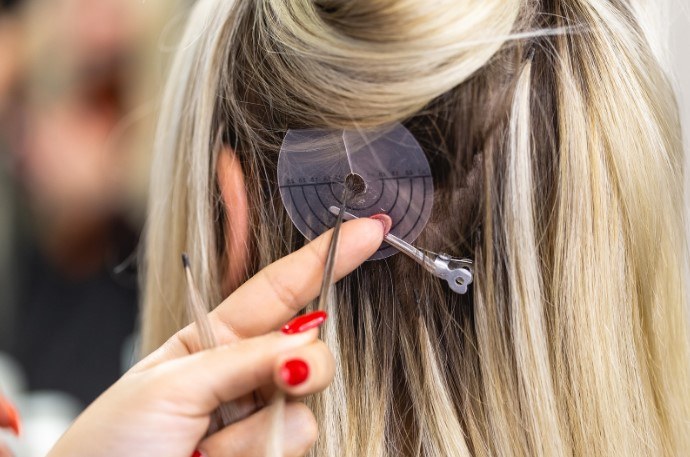
The most useful habit to take from this guide is simple: judge the match with water. Before any decision about shade, length or method, wet a section of your natural hair and the sample extension, let both spring into their true shapes and compare them side by side. If they curl at the same width, shrink by the same amount and move in the same rhythm, the colour can be handled afterwards. If they do not, no shade in the world will save the result.
Curly hair extensions reward patience at the start. Book a consultation with your hair worn natural, bring your photos and shrinkage measurements, and choose a specialist who treats texture as the starting point, as Ivana Farisei does. That order of decisions is what makes extensions look like they belong to you.